A Practical, Compassionate Guide For Caregivers
Of Children Ages 3–9 Who Want More Cooperation, Fewer Struggles, And A Calmer Way To Respond.
A Practical, Compassionate Guide For Caregivers Of Children Ages 3–9 Who Want More Cooperation, Fewer Struggles, And A Calmer Way To Respond.
If you’re tired of repeating yourself, overwhelmed by daily resistance, and worn down by emotional blowups, this guide was created to help you build a calmer, more connected pattern without relying on yelling, threats, or constant battles.

You’re Not Looking for Perfection.
You’re Looking for a Better Way.
There are caregivers who feel trapped in a cycle of escalation repeating, warning, threatening, and finally snapping just to get through basic routines.
And then there are caregivers who know, deep down, that while boundaries matter, there has to be a more grounded way to guide a child.
You’re here because you want something better.
❌ Not permissiveness.
❌ Not chaos.
❌ Not “letting kids run the house.”
You want your child to listen without every request becoming a standoff.
You want to hold boundaries without losing your cool.
You want more cooperation, more connection, and less guilt at the end of the day.
You want to feel like the kind of caregiver you know you can be.
Get Instant Access
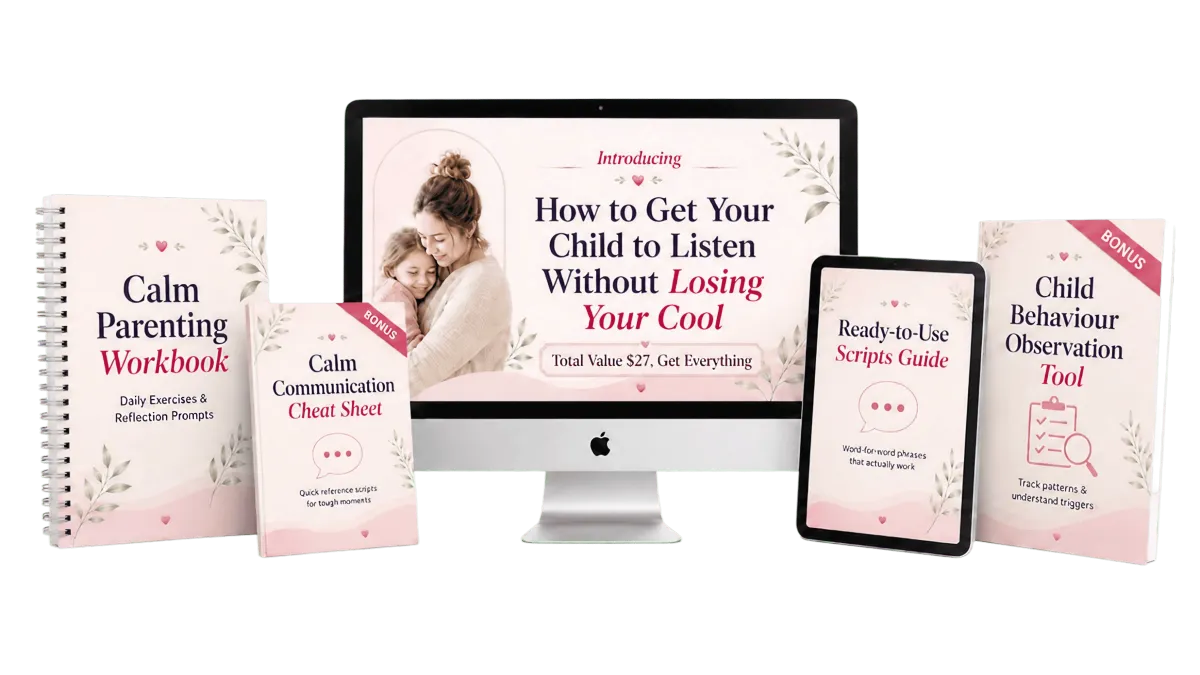
Regular Price: $97
Your price: $27
You're Saving $70 Today

🔒 100% Secure 256-Bit Encryption
✅ Instant Access After Purchase
📧 Order Confirmation Sent Immediately
💯 30-Day Money-Back Guarantee
You’re Not Looking for Perfection.
You’re Looking for a Better Way.
There are caregivers who feel trapped in a cycle of escalation repeating, warning, threatening, and finally snapping just to get through basic routines.
And then there are caregivers who know, deep down, that while boundaries matter, there has to be a more grounded way to guide a child.
You’re here because you want something better.
❌ Not permissiveness.
❌ Not chaos.
❌ Not “letting kids run the house.”
You want your child to listen without every request becoming a standoff.
You want to hold boundaries without losing your cool.
You want more cooperation, more connection, and less guilt at the end of the day.
You want to feel like the kind of caregiver you know you can be.
Get Instant Access
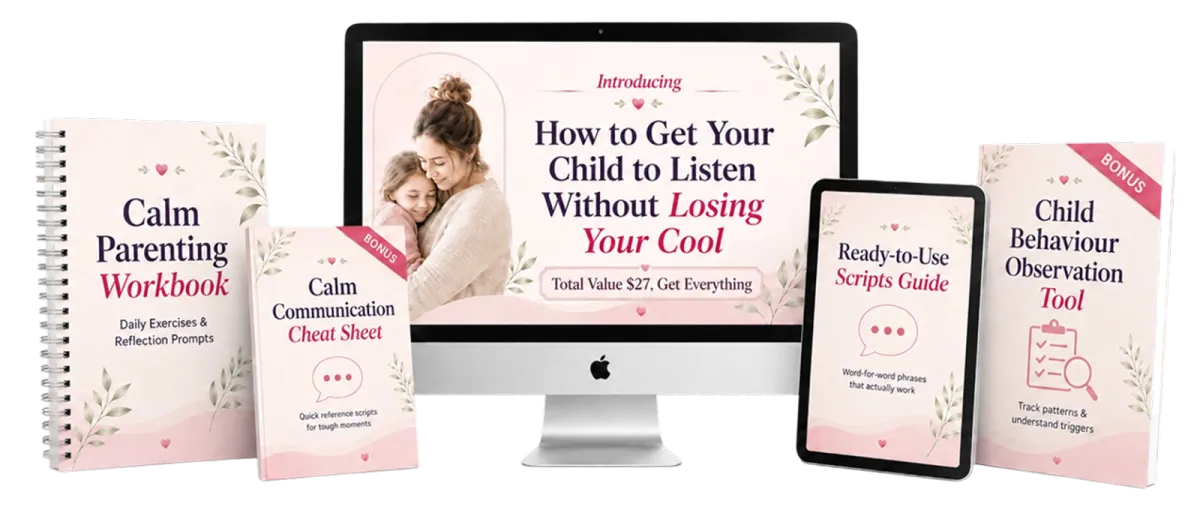
Regular Price: $97
Your price: $27
You're Saving $70 Today
🔒 100% Secure 256-Bit Encryption
✅ Instant Access After Purchase
📧 Order Confirmation Sent Immediately
💯 30-Day Money-Back Guarantee
If You’re Like Many Caregivers, the Hardest Part Isn’t Just the Behavior It’s the Pattern
Right now, you may be:
Repeating the same instruction again and again
Feeling dread around bedtime, homework, transitions, or getting out the door
Watching little moments turn into big emotional struggles
Trying to stay patient until suddenly you can’t anymore
Feeling guilty after yelling, even when you were completely overwhelmed
Wondering why your child seems to resist even basic requests
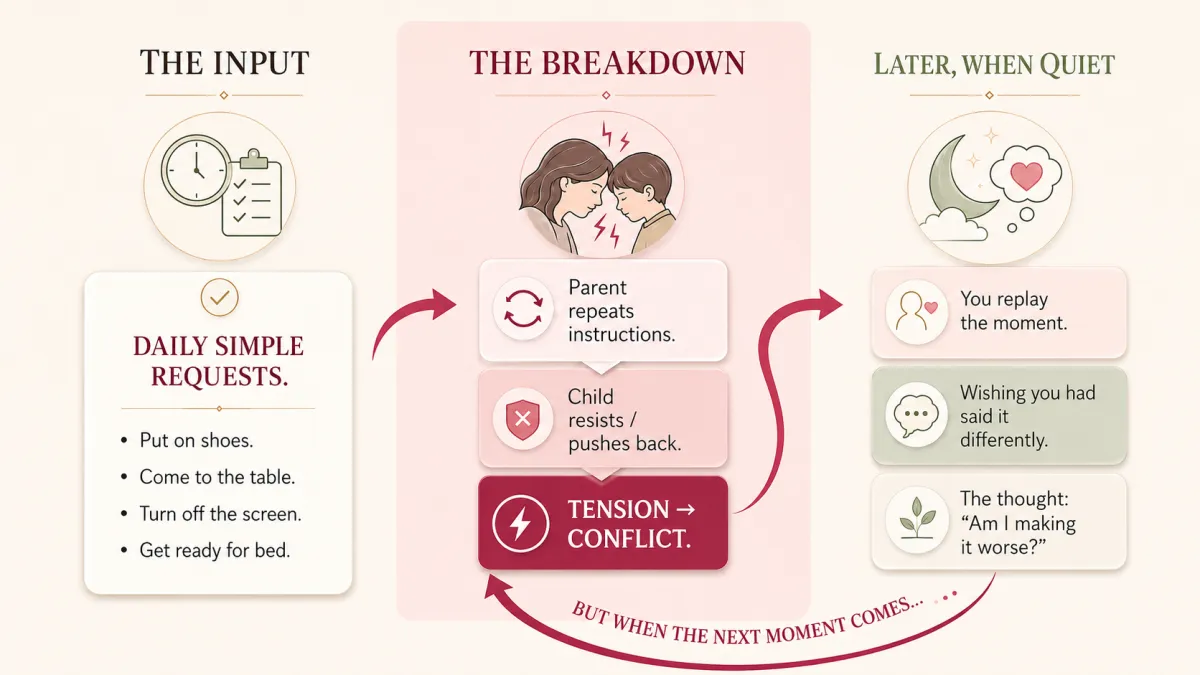
And the hardest part is that it rarely feels like it should be this hard.
You ask for something simple.
Put on your shoes. Come to the table. Turn off the screen. Start getting ready for bed.
And somehow, that simple moment becomes tension… then resistance… then conflict.
You repeat yourself. Your child pushes back. Your voice changes. The whole tone of the house shifts.
Later, when everything is finally quiet, you replay it all in your head.
You think about what you wish you had said differently.
You wonder if you're making things worse.
You promise yourself you'll stay calmer next time.
But when the next difficult moment comes, the same pattern takes over again.
Not because you don't care.
Because you care so much and you've been trying to navigate hard moments without a clear framework that actually helps in real time.
Why So Many Caregivers Stay Stuck in the Same Cycle
A lot of parenting advice focuses only on the surface:
How to stop the behavior. How to correct the child. How to get compliance faster.
So caregivers try:
Firmer instructions
Repeated reminders
Countdowns
Warnings
Consequences
Trying to stay calm until they suddenly snap
Going back and forth between strictness and exhaustion
But many of these approaches don’t address what’s happening underneath the struggle.
Because often, the issue isn’t just the task itself.
It’s the interaction pattern.
It's what happens when a child feels pressured, corrected, cornered, or disconnected… and an overwhelmed adult is trying to create order with no space to slow the dynamic down.
That doesn’t mean children should have no boundaries.
It means the way boundaries are communicated can either increase defensiveness… or reduce it.
And when defensiveness goes down, cooperation becomes much more possible.
That is the shift this guide is designed to help you make.
In this guide you will learn:
How to stop repeating instructions
What to say instead of yelling
How to reduce power struggles in daily routines
A simple framework to guide children calmly

Why Santosh Created This Guide
Santosh’s work began with lived experience.
He grew up as the energetic, curious middle child in a busy home with working parents. In that environment, he knew what it felt like to be seen as “the difficult one.”
Growing up as the energetic, curious middle child in a busy home, he knew what it felt like to be labeled “the difficult one.”
That early experience shaped his lifelong interest in understanding the emotional dynamics between caregivers and children.
But underneath that label wasn’t a child trying to cause problems.
it was a child trying to connect.
Trying to be seen.
Trying to be understood.
That experience stayed with him.
Over time, it shaped a deeper realization:
Many struggles between adults and children aren’t only about behavior.
They are also about misunderstanding, emotional disconnection, and the ways everyday interactions can unintentionally become battles.
Rather than staying trapped inside those patterns, Santosh chose growth and healing.
And through that process, he became committed to helping caregivers feel more confident, more supported, and more equipped to guide children in ways that protect both connection and boundaries.
This guide is part of that mission.
Introducing
How to Get Your Child to Listen
Without Losing Your Cool
A step-by-step guide for caregivers of children ages 3–9 who want to reduce power struggles,
respond more calmly, and encourage more cooperation in everyday family life.
This is not about becoming permissive. It is not about forcing obedience through fear. And it is not about pretending difficult moments disappear. It is about learning how to respond in a way that reduces unnecessary conflict while keeping expectations clear.
Inside, you’ll learn practical tools and communication shifts designed to help you understand what’s happening, respond with greater clarity, and create calmer patterns over time.
✅ Get Instant Access / 💯 30-Day Money-Back Guarantee
Here’s What You’ll Learn Inside
Chapter 1
The Big Why
Learn Santosh's story and the hope framework behind this approach — so you can understand the deeper purpose of changing how you respond and what becomes possible when you do.
Chapter 2
Seeing the World Through Children's Eyes
Learn observation techniques that help you better understand behavior patterns and what may be happening beneath the surface.
Chapter 3
Creating Calm Through Clear Boundaries
Discover the 3-rule system for creating structure that is simple, positive, and consistent.
Chapter 4
Turning Conflict into Connection
Explore positive reinforcement and calm communication strategies designed to reduce power struggles and support cooperation.
Chapter 5
Melissa's Story
Read a real transformation case study that shows how these ideas can play out in family life.
Chapter 6
Troubleshooting & FAQs
Get guidance for common challenges, questions, and sticking points that comes up when changing familiar patterns.
Chapter 7
Bonus Tools + Next Steps
Access additional resources and next-step guidance for continuing the work.
Core Frameworks Taught in the Guide
This guide goes beyond general encouragement and gives you practical frameworks to use in everyday moments, including:
The 15-minute observation exercise for understanding behavior patterns
The 3 Golden Family Rules system for simple, positive, consistent boundaries
“Say This, Not That”
communication swaps for more effective responses during hard momentsThe Problem-Agitation-Solution emotional regulation sequence
These tools are designed to help you move from reacting automatically… to respond with greater awareness, steadiness, and intention.
What This Guide Is Designed to Help You Change
Immediate Relief
- fewer repeated instructions
- shorter conflicts
- calmer recovery after emotional moments
Emotional Transformation
- reduced guilt
- increased confidence
- greater emotional safety in the home
Behavioral Changes
- more cooperation during everyday routines like bedtime, homework, and transitions
Long-Term Impact
- stronger connection-based cooperation
- healthier interaction patterns over time
This is not about becoming a perfect caregiver or raising a perfect child.
It is about creating a better pattern — one grounded in clarity, connection, and more sustainable cooperation.
Why This Approach Feels Different
Many resources tell caregivers to “stay calm,” but don’t tell them what to actually do when resistance shows up in real life.
This guide is designed to be practical.
It helps you understand:
what may be driving resistance
How communication can unintentionally escalate the struggle
what kinds of shifts can lower defensiveness
How to create clearer boundaries without unnecessary conflict
Instead of asking you to choose between harshness and helplessness, it offers another path:
A path built on structure, understanding, and more intentional communication.
Imagine What Everyday Life Could Start to Feel Like
Imagine asking once without immediately bracing for a power struggle.
Imagine getting through bedtime with less tension.
Imagine catching a hard moment earlier before it spirals.
Imagine having words to lean on when your emotions are rising.
Imagine feeling more grounded in your boundaries instead of swinging between frustration and guilt.
Imagine ending the day feeling more connected to your child… and more aligned with the kind of caregiver you want to be.
Not because everything becomes easy.
But because you finally have tools for the moments that used to throw everything off course.
That is the kind of shift this guide is designed to support.
Who This Is For
This Guide Is For You If You…
For caregivers of children ages 3–9 who:
- Are emotionally invested but overwhelmed
- Are tired of constant power struggles
- Do not want yelling to become their default
- Want practical communication tools, not vague advice
- Care about both connection and boundaries
- Want a calmer, more sustainable way to guide behavior
If You've Ever Thought…
You're not alone in feeling this way:
- "Why do I have to say everything so many times?"
- "Why does every routine turn into a battle?"
- "I know yelling isn't helping, but I don't know what to do instead."
- "I want to handle these moments differently."
This guide was made with you in mind.
Why This Matters Now
The years between ages 3 and 9 are an important time for shaping relationship patterns, emotional responses, and everyday routines inside the home.
That doesn’t mean you need to panic.
And it doesn’t mean you need to do this perfectly.
It simply means that if you’ve been feeling stuck, this is a meaningful time to begin creating a different pattern.
Because small shifts, practiced consistently, can change the feel of everyday life in powerful ways.
What You're Really Investing In
You’re not just investing in a guide.
You’re investing in:
a calmer way to approach difficult moments
more clarity when emotions run high
communication tools you can return to again and again
a more connected pattern in everyday family life
support for becoming the caregiver you want to be
When you have a framework, hard moments stop feeling so random.
You begin to understand what’s happening.
You begin to respond with more intention.
And over time, that changes the emotional tone of the home.
Get Instant Access
Regular Price: $97
Your price: $27
You're Saving $70 Today
🔒 100% Secure 256-Bit Encryption
✅ Instant Access After Purchase
📧 Order Confirmation Sent Immediately
💯 30-Day Money-Back Guarantee
Your Next Step
If you're tired of repeating yourself… if you want fewer battles and more cooperation…
if you want a calmer way to guide your child without losing your cool
How to Get Your Child to Listen Without Losing Your Cool gives you a practical place to begin.
✅ Get Instant Access / 💯 30-Day Money-Back Guarantee

100% Money-Back Guarantee
Try How to Get Your Child to Listen Without Losing Your Cool for 30 Days. If you go through the guide, apply the strategies, and don’t feel more calm, clear, or confident in how you handle difficult parenting moments… Simply email us within 30 days and we’ll refund you.
❌ No awkward questions. ❌ No complicated steps. ❌ No stress.
The only real risk is staying stuck in the same exhausting cycle when there’s a calmer way forward.
Frequently Asked Questions
Who is this guide for?
This guide is written for caregivers of children ages 3–9 who want calmer, more connected ways to guide behavior and reduce daily power struggles.
Is this about being permissive?
No. The guide focuses on clear boundaries, practical communication, and reducing unnecessary escalation — not removing structure.
What’s included in the guide?
The guide includes 7 chapters covering Santosh’s story and hope framework, observation techniques, the 3-rule system, positive reinforcement and calm communication, Melissa’s real transformation case study, troubleshooting and FAQs, plus bonus tools and next steps.
What frameworks are taught?
You’ll learn:
the 15-minute observation exercise
the 3 Golden Family Rules system
“Say This, Not That” communication swaps
the Problem-Agitation-Solution emotional regulation sequence
What kinds of changes is this designed to support?
This guide is designed to help you experience:
fewer repeated instructions
shorter conflicts
calmer recovery after emotional moments
reduced guilt
increased confidence
more cooperation during routines
stronger connection-based cooperation over time
Is this a quick fix?
No. This is a practical guide designed to help you build healthier communication and cooperation patterns over time.
What if I’m not naturally calm?
That’s exactly why practical tools matter. This guide is meant to support real caregivers in real moments, not demand perfection.
Will this work for strong-willed children?
The guide may be especially useful for caregivers who want to support cooperation while still respecting a child’s need for agency, voice, and boundaries.
Is Melissa’s story a real case study?
Yes. The guide includes Melissa’s story as a real transformation case study.
What are the bonus tools?
The guide includes bonus tools and next steps. These can be listed in more detail once the final resource set is fully defined.
A Final Word
You do not need to keep repeating the same exhausting cycle.
You do not need to choose between harshness and helplessness.
And you do not need to figure all of this out alone through trial and error.
There is a calmer path. A more connected path. A more intentional path.
This guide was created to help you start walking that path.
✅ Get Instant Access / 💯 30-Day Money-Back Guarantee
How to Get Your Child to Listen Without Losing Your Cool
A Practical, Compassionate Guide For Caregivers Of Children Ages 3–9 Who Want More Cooperation, Fewer Struggles, And A Calmer Way To Respond.

❌ You’re Not Looking For Perfection.
✅ You’re Looking For a Better Way.

There are caregivers who feel trapped in a cycle of escalation — repeating, warning, threatening, and finally snapping just to get through basic routines.
And then there are caregivers who know, deep down, that while boundaries matter, there has to be a more grounded way to guide a child.
You’re here because you want something better.
❌ Not permissiveness.
❌ Not chaos.
❌ Not “letting kids run the house.”
✅ You want your child to listen without every request becoming a standoff.
✅ You want to hold boundaries without losing your cool.
✅ You want more cooperation, more connection, and less guilt at the end of the day.
✅ You want to feel like the kind of caregiver you know you can be.
If You're Like Many Caregivers, The Hardest Part Isn't Just The Behaviour, It's The Pattern
Right now, you may be:
Repeating the same instruction again and again
Feeling dread around bedtime, homework, transitions, or getting out the door
Watching little moments turn into big emotional struggles
Trying to stay patient until suddenly you can’t anymore
Feeling guilty after yelling, even when you were completely overwhelmed
Wondering why your child seems to resist even basic requests
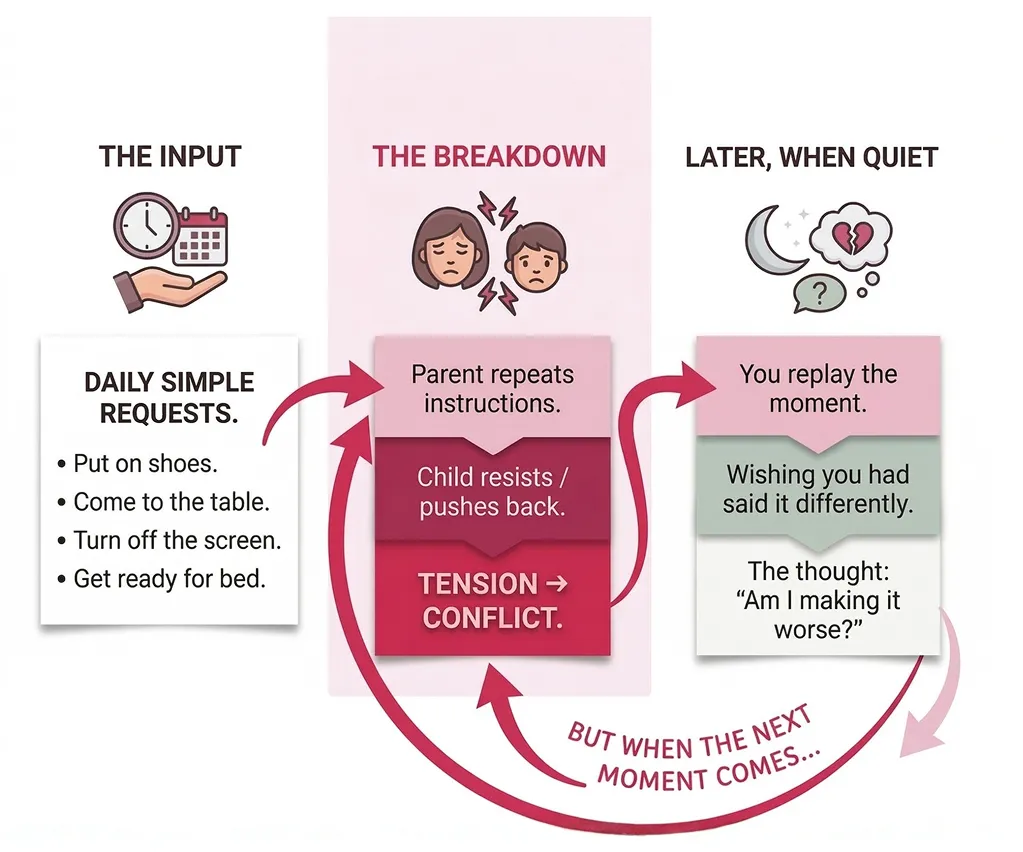
And the hardest part is that it rarely feels like it should be this hard.
You ask for something simple.
Put on your shoes.
Come to the table.
Turn off the screen.
Start getting ready for bed.
And somehow, that simple moment becomes tension… then resistance… then conflict.
You repeat yourself.
Your child pushes back.
Your voice changes.
The whole tone of the house shifts.
Later, when everything is finally quiet, you replay it all in your head.
You think about what you wish you had said differently.
You wonder if you’re making things worse.
You promise yourself you’ll stay calmer next time.
But when the next difficult moment comes, the same pattern takes over again.
Not because you don’t care.
Because you care so much — and you’ve been trying to navigate hard moments without a clear framework that actually helps in real time.
Why So Many Caregivers Stay Stuck in the Same Cycle
A lot of parenting advice focuses only on the surface:
How to stop the behavior.How to correct the child.How to get compliance faster.
So caregivers try:
Firmer instructions
Repeated reminders
Countdowns
Warnings
Consequences
Trying to stay calm until they suddenly snap
Going back and forth between strictness and exhaustion

But many of these approaches don’t address what’s happening underneath the struggle.
Because often, the issue isn’t just the task itself.
It’s the interaction pattern.
It’s what happens when a child feels pressured, corrected, cornered, or disconnected… and an overwhelmed adult is trying to create order with no space to slow the dynamic down.
That doesn’t mean children should have no boundaries.
It means the way boundaries are communicated can either increase defensiveness… or reduce it.
And when defensiveness goes down, cooperation becomes much more possible.
That is the shift this guide is designed to help you make.
In this guide you will learn:
How to stop repeating instructions
What to say instead of yelling
How to reduce power struggles in daily routines
A simple framework to guide children calmly
Why So Many Caregivers Stay Stuck in the Same Cycle
A lot of parenting advice focuses only on the surface:
How to stop the behavior.How to correct the child.How to get compliance faster.
So caregivers try:
Firmer instructions
Repeated reminders
Countdowns
Warnings
Consequences
Trying to stay calm until they suddenly snap
Going back and forth between strictness and exhaustion
But many of these approaches don’t address what’s happening underneath the struggle.
Because often, the issue isn’t just the task itself.
It’s the interaction pattern.
It’s what happens when a child feels pressured, corrected, cornered, or disconnected… and an overwhelmed adult is trying to create order with no space to slow the dynamic down.
That doesn’t mean children should have no boundaries.
It means the way boundaries are communicated can either increase defensiveness… or reduce it.
And when defensiveness goes down, cooperation becomes much more possible.
That is the shift this guide is designed to help you make.
In this guide you will learn:
How to stop repeating instructions
What to say instead of yelling
How to reduce power struggles in daily routines
A simple framework to guide children calmly
Why Santosh Created This Guide
Santosh’s work began with lived experience.
He grew up as the energetic, curious middle child in a busy home with working parents.
In that environment, he knew what it felt like to be seen as “the difficult one.”
Growing up as the energetic, curious middle child in a busy home, he knew what it felt like to be labeled “the difficult one.”
That early experience shaped his lifelong interest in understanding the emotional dynamics between caregivers and children.
But underneath that label wasn’t a child trying to cause problems.
It was a child trying to connect.
Trying to be seen.
Trying to be understood.
That experience stayed with him.
Over time, it shaped a deeper realization:
Many struggles between adults and children are not only about behavior.
Many struggles between adults and children aren’t only about behavior.
They are also about misunderstanding, emotional disconnection, and the ways everyday interactions can unintentionally become battles.
Rather than staying trapped inside those patterns, Santosh chose growth and healing.
And through that process, he became committed to helping caregivers feel more confident, more supported, and more equipped to guide children in ways that protect both connection and boundaries.
This guide is part of that mission.

A step-by-step guide for caregivers of children ages 3–9 who want to reduce power struggles, respond more calmly, and encourage more cooperation in everyday family life.
❌ This is not about becoming permissive.
❌ It is not about forcing obedience through fear.
❌ And it is not about pretending difficult moments disappear.
✅ It is about learning how to respond in a way that reduces unnecessary conflict while keeping expectations clear.
Inside, you’ll learn practical tools and communication shifts designed to help you understand what’s happening, respond with greater clarity, and create calmer patterns over time.
Here’s What You’ll Learn Inside
Chapter 1: The Big Why
Learn Santosh’s story and the hope framework behind this approach — so you can understand the deeper purpose of changing how you respond and what becomes possible when you do.
Chapter 2: Seeing the World Through Children’s Eyes
Learn observation techniques that help you better understand behavior patterns and what may be happening beneath the surface.
Chapter 3: Creating Calm Through Clear Boundaries
Discover the 3-rule system for creating structure that is simple, positive, and consistent.
Chapter 4: Turning Conflict into Connection
Explore positive reinforcement and calm communication strategies designed to reduce power struggles and support cooperation.
Chapter 5: Melissa’s Story
Read a real transformation case study that shows how these ideas can play out in family life.
Chapter 6: Troubleshooting & FAQs
Get guidance for common challenges, questions, and sticking points he grew up as the energetic, curious middle child in a busy home with working parents.
In that environment, he knew what it felt like to be seen as “the difficult one.”
Growing up as the energetic, curious middle child in a busy home, he knew what it felt like to be labeled “the difficult one.”
That comes up when changing familiar patterns.
Chapter 7: Bonus Tools + Next Steps
Access additional resources and next-step guidance for continuing the work.
Core Frameworks Taught in the Guide
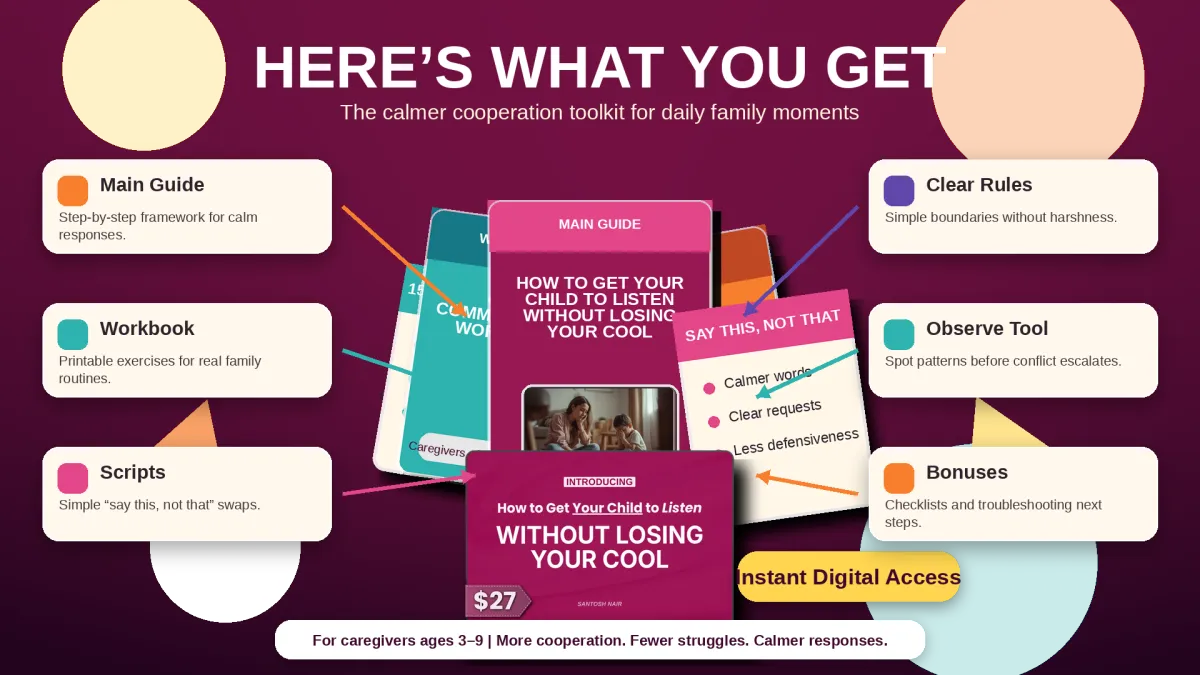
This guide goes beyond general encouragement and gives you practical frameworks to use in everyday moments, including:
The 15-minute observation exercise for understanding behavior patterns
The 3 Golden Family Rules system for simple, positive, consistent boundaries
“Say This, Not That” communication swaps for more effective responses during hard moments
The Problem-Agitation-Solution emotional regulation sequence
The Problem-Agitation-Solution emotional regulation sequence
These tools are designed to help you move from reacting automatically... to respond with greater awareness, steadiness, and intention.
What This Guide Is Designed to Help You Change
Immediate Relief
Fewer repeated instructions
Shorter conflicts
Calmer recovery after emotional moments
Emotional Transformation
Reduced guilt
Increased confidence
Greater emotional safety in the home
Behavioral Changes
More cooperation during everyday routines like bedtime, homework, and transitions
Long-Term Impact
Stronger connection-based cooperation
Healthier interaction patterns over time
This is not about becoming a perfect caregiver or raising a perfect child.
It is about creating a better pattern — one grounded in clarity, connection, and more sustainable cooperation.
Why This Approach Feels Different
Many resources tell caregivers to “stay calm,” but don’t tell them what to actually do when resistance shows up in real life.
This guide is designed to be practical.
It helps you understand:
What may be driving resistance
How communication can unintentionally escalate the struggle
What kinds of shifts can lower defensiveness
How to create clearer boundaries without unnecessary conflict
Instead of asking you to choose between harshness and helplessness, it offers another path:
A path built on structure, understanding, and more intentional communication.
Imagine What Everyday Life Could Start to Feel Like
Imagine asking once without immediately bracing for a power struggle.
Imagine getting through bedtime with less tension.
Imagine catching a hard moment earlier — before it spirals.
Imagine having words to lean on when your emotions are rising.
Imagine feeling more grounded in your boundaries instead of swinging between frustration and guilt.
Imagine ending the day feeling more connected to your child… and more aligned with the kind of caregiver you want to be.
Not because everything becomes easy.
But because you finally have tools for the moments that used to throw everything off course.
That is the kind of shift this guide is designed to support.
Who This Is For
This guide is for caregivers of children ages 3–9 who:
Are emotionally invested but overwhelmed
Are tired of constant power struggles
Do not want yelling to become their default
Want practical communication tools, not vague advice
Care about both connection and boundaries
Want a calmer, more sustainable way to guide behavior
If you’ve ever thought:
“Why do I have to say everything so many times?”
“Why does every routine turn into a battle?”
“I know yelling isn’t helping, but I don’t know what to do instead.”
“I want to handle these moments differently.”
This guide was made with you in mind.
Why This Matters Now
The years between ages 3 and 9 are an important time for shaping relationship patterns, emotional responses, and everyday routines inside the home.
That doesn’t mean you need to panic.
And it doesn’t mean you need to do this perfectly.
It simply means that if you’ve been feeling stuck, this is a meaningful time to begin creating a different pattern.
Because small shifts, practiced consistently, can change the feel of everyday life in powerful ways.
What You’re Really Investing In
You’re not just investing in a guide.
You’re investing in:
A calmer way to approach difficult moments
More clarity when emotions run high
Communication tools you can return to again and again
A more connected pattern in everyday family life
Support for becoming the caregiver you want to be
When you have a framework, hard moments stop feeling so random.
You begin to understand what’s happening.
You begin to respond with more intention.
And over time, that changes the emotional tone of the home.
Your Next Step
1. If you’re tired of repeating yourself…
2. If you want fewer battles and more cooperation…
3. If you want a calmer way to guide your child without losing your cool—
Get Instant Access Now - $27
🔒 100% Secure 256-Bit Encryption
✅ Instant Access After Purchase
📧 Order Confirmation Sent Immediately
💯 30-Day Money-Back Guarantee

A FINAL WORD
❌ You do not need to keep repeating the same exhausting cycle.
❌ You do not need to choose between harshness and helplessness.
❌ And you do not need to figure all of this out alone through trial and error.
✅ There is a calmer path.
✅ A more intentional path.
This guide was created to help you start walking that path.
✅ Get Instant Access / 💯 30-Day Money-Back Guarantee
NOT FACEBOOK™: This site is not a part of the Facebook™ website or Facebook Inc. Additionally, this site is NOT endorsed by Facebook™ in any way. FACEBOOK™ is a trademark of FACEBOOK™, Inc.